Understanding Retirement Living: Is it Right for You?

Deciding where to spend your retirement years is deeply personal, often emotional, and for many of us, one of the most difficult decisions we will make in our lifetime. It’s easy to become overwhelmed by the logistics of moving decades’ worth of belongings and where to start. It’s also easy to become overwhelmed by the notion of leaving the decades of memories woven into the walls of your current home.
The good news is that memories live inside of us and we can carry them wherever we go and revisit them whenever we need. And the even better news? If you’ve reached the point of asking yourself, “Is moving to a retirement living community right for me?” — you’ve already taken the first step toward something new, and you don’t have to walk that path alone. At Concordia, we’ve had the privilege of guiding many individuals and families through this important chapter of life. We know that the question posed above takes most people months to answer. And we’re here to help! Let’s explore what retirement living really means, how it compares to other levels of care and what retirement community benefits and lifestyle options you can expect at Concordia.
What is Retirement Living?
Retirement living, often called independent living, offers a worry-free lifestyle for older adults who want to enjoy all the perks of home ownership without the responsibilities. You can come and go as you please, involve yourself in as many or as little campus activities as you want and decorate your apartment, cottage or villa to reflect your personal design tastes. Quite simply, it’s home – your home.
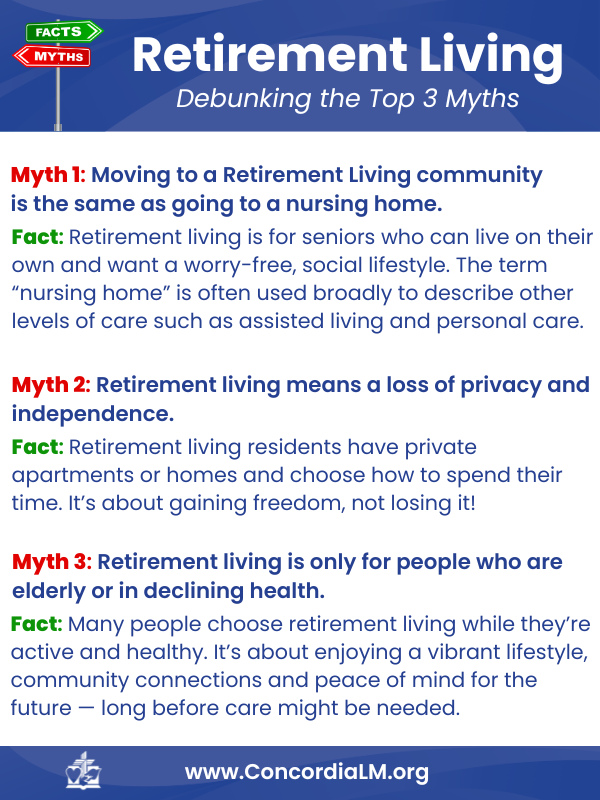
To help best understand what retirement living is, let’s look at what it’s not. The term “nursing home” is used broadly by many people outside of the healthcare industry as a blanket term to describe all levels of care within a senior living community. The term is most often used to describe other levels of care such as assisted living, long-term nursing care and personal care.
Retirement living is distinct from these levels of care – it’s designed for individuals who are still active and independent. And yet, the terminology can still be confusing, especially for those just beginning to explore options within a continuing care retirement community.
Julie Spirnock, admissions counselor for Highpointe at Rebecca, speaks with individuals considering a move to a retirement living community daily and often hears misconceptions about what that move really means.
“Some people think moving into a retirement community is like moving into a nursing home. This could not be further from the truth,” she said. “Retirement living is designed for seniors who are still active, self-sufficient and looking for a maintenance-free lifestyle. They can travel, host guests and live just as independently as they did before they moved.”
Related: Concordia Dictionary: A Guide to Retirement Living Terms
So where does retirement living fit in within the broader senior care landscape?
A continuing care retirement community (CCRC) is a senior living setting that offers multiple levels of care on the same campus, including retirement living, assisted living or personal care, long-term nursing care, short-term care, rehabilitation services and more. The model is designed to allow residents to age in place. Retirement living residents may never have the need for short-term care, but if they do, they can just go next door. At Concordia, all of our retirement living communities are within a CCRC setting, providing peace of mind to our residents that support is available when or if it is needed.
Signs You Might Be Ready for Retirement Living
Earlier, we posed the question: “Is moving to a retirement living community right for me?” Now that you have a clearer picture of what retirement living truly is – a worry-free lifestyle rooted in independence, comfort and community – the next question becomes more personal: “Am I ready for retirement living?”
There’s no one-size-fits-all answer. But if you’re starting to think about a simpler, more connected lifestyle or just desire a little more peace of mind about the future, that may be your gentle nudge to take the next step. Here are a few common signs that it might be time to explore the possibilities ahead:
- You’re ready to simplify or downsize: Maybe the house feels too big, or the upkeep is starting to feel like more effort than it’s worth. You’re desiring a space that’s easier to manage and more reflective of how you live now.
- You’re seeking more social engagement: You enjoy your independence, but you’re also ready to be part of a community where activities are right outside your door and there’s always an opportunity to meet new friends. Whether it’s group outings, game nights or sharing a meal with neighbors, you’re looking to build meaningful relationships within a welcoming community.
- Daily tasks are starting to feel like burdens: The to-do list has become never-ending and exhausting. From shoveling snow and mowing the lawn to cooking every meal, there’s always something that is keeping you from enjoying life to its fullest and you’re ready to hand off some of the heavy lifting.
- You want peace of mind about the future: Even though you are healthy and independent now, you are thinking ahead. You want to be somewhere that can support you later, if your needs ever change.
Related: Rightsizing for Retirement Living
Why Consider Concordia?
If you’re beginning to picture your next chapter in a retirement living community, Concordia offers a variety of options designed to meet you where you are and support where you’re going. With a reputation for compassionate, high-quality care and a commitment to value and affordability, we’ve been a trusted name in senior living for over a century.
Our retirement communities across western Pennsylvania and eastern Ohio offer something for everyone:
- Prefer small-town charm and scenic views? Visit Concordia at Bethlen and Concordia at Cabot.
- Looking for proximity to the city? Consider Concordia of the South Hills and Concordia of Bridgeville.
- Want the best of both worlds? Highpointe at Rebecca and Concordia at Sumner offer that perfect balance.
No matter the location, all our communities offer convenient access to shops and grocery stores, entertainment and healthcare – whether you prefer to drive yourself or use our transportation services. Residents enjoy beautiful private apartments, cottages or villages, enriching activities, on-site amenities and, most importantly, a welcoming community rooted in faith and service.
Related: Creative Retirement Living at Concordia
Peace of Mind for Whatever Comes Next
It’s completely natural to have questions – especially about what the future might hold. Christine Lucas, admissions counselor at Concordia at Bethlen, hears it often.
“The most common questions I hear start with, ‘What happens if…’” she said. “What happens if I need care later? What if something changes? At Concordia, we can help – whether that’s in the home, through rehab or a move to personal care. We’re here for whatever comes next.” That kind of peace of mind is one of the most reassuring parts of choosing retirement living in a continuing care retirement community. You don’t need all the answers today – but knowing you have options, support and trusted people by your side makes the decision a little easier.
Ready to take the next step? Click the button below to download our free guide, Questions to Ask When Searching for the Right Living Community, and start exploring what’s possible.
At Concordia, we believe retirement is a new beginning and where community, comfort and care intersect. If you’re ready to explore a lifestyle full of opportunity, contact us today through our online form or by calling us at 724-352-1571.
Founded in 1881, Concordia Lutheran Ministries is a faith-based, CARF-accredited Aging Services Network and recipient of the inaugural Pennsylvania Department of Aging Excellence in Quality Care Award. As one of the largest nonprofit senior care providers in the country, the organization serves 50,000 people annually through in-home care and inpatient locations.
Get Updates From Concordia
There is always a LOT happening at Concordia! Would you like to stay up-to-date with our news and events? Sign up for our monthly e-newsletter here.